Beautiful.ai vs Gamma vs Pitch: Which AI Presentation Tool Is Worth Your Money?
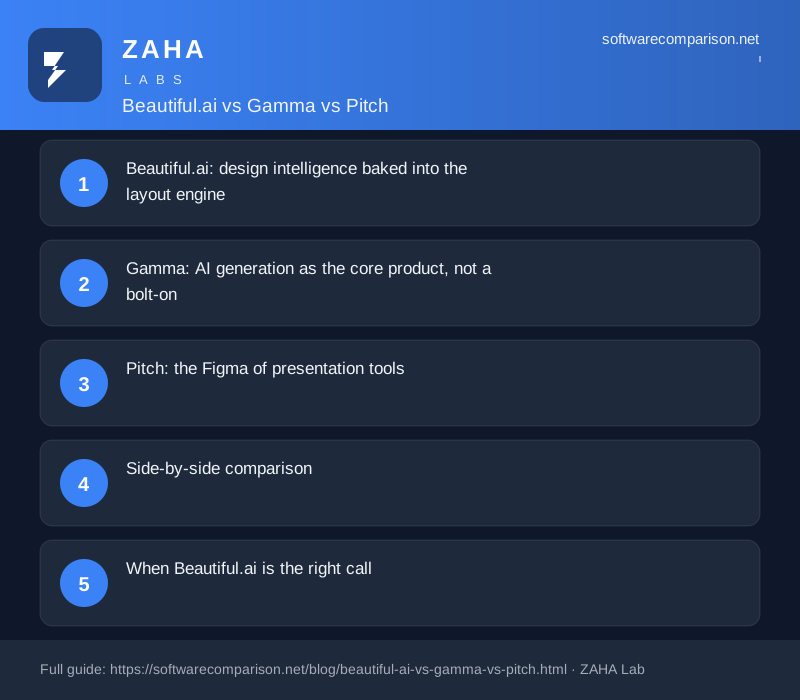
Three tools, three very different philosophies. Beautiful.ai automates design. Gamma generates entire decks from a prompt. Pitch is built around real-time team collaboration. The right answer depends entirely on what your biggest bottleneck actually is.
The market for AI presentation tools has quietly become one of the more crowded corners of the productivity software space. Three names come up in nearly every conversation: Beautiful.ai, Gamma, and Pitch. Each has earned genuine fans. Each also has real weaknesses the marketing copy tends to bury.
This comparison draws on extended hands-on use of all three. I have built decks for investor pitches, internal strategy reviews, client briefings, and product launches using each tool. The differences are sharper in practice than the feature lists suggest.
Beautiful.ai: design intelligence baked into the layout engine
Beautiful.ai, founded in 2018 in San Francisco, built its reputation on what it calls SmartSlide technology. The premise is straightforward: when you add content to a slide, the layout adjusts automatically rather than falling apart. Add a fourth bullet point and the spacing recalibrates. Drop in a longer headline and the type scales to fit. Switch from a two-column layout to three and the proportions update across every element on that slide.
It sounds like a minor convenience until you have spent twenty minutes nudging text boxes in PowerPoint to realign after editing a single sentence. SmartSlide genuinely solves a real frustration, and it does so without requiring you to understand anything about design.
The template library runs to over 60 professionally designed starting points — investor decks, product roadmaps, team updates, sales presentations — each with multiple slide variants so you are not stuck repeating the same visual pattern throughout. The brand kit feature is the standout for organisations that build decks regularly: upload your fonts, colour palette, and logo once, apply globally, and every new presentation starts on-brand without manual setup.
Where Beautiful.ai shows its limits is in AI generation. It does not produce decks from a text prompt. The AI sits beneath the surface, handling layout intelligence, rather than acting as a content creator. You still write your own slides. Some users will consider this a feature — the content stays entirely yours — but if you need to go from a rough brief to a working deck in five minutes, Beautiful.ai will not help you do that.
Collaboration is workable rather than impressive. Multiple users can edit the same presentation, and there is a version history you can roll back through. Team plans include workspace management and permission controls. It is adequate for small teams with a clear primary author, but it does not have Pitch's real-time co-editing quality.
Pricing: Free (limited slides, watermarked exports), Pro at $12 per month billed annually, Team at $40 per user per month.
Gamma: AI generation as the core product, not a bolt-on
Gamma arrived with a genuinely different premise: the AI should create the whole deck for you. Type a prompt — "create a pitch deck for a B2B SaaS platform that helps independent restaurants manage supplier relationships" — and Gamma produces a full-length, structured presentation in roughly thirty seconds. The result is a real first draft, not a set of blank slides with suggested headings. The structure is logical, the headlines are relevant, and the visual layouts are clean out of the box.
The underlying format is worth understanding because it changes what Gamma is actually useful for. Gamma calls its content units "cards" rather than slides, and they behave more like rich document sections than traditional PowerPoint frames. Each card can contain embedded web content, video, charts, live data, or interactive toggles. The output can be shared as a standalone web page, exported as a PDF or PowerPoint file, or presented full-screen in presentation mode. This flexibility makes Gamma genuinely useful for content formats that sit between a deck and a document — client briefings, internal strategy reviews, onboarding materials, or knowledge-base articles that also need to be presentable.
The AI tools extend beyond generation. Select any card and ask the AI to rewrite it in a different tone, expand it with supporting detail, simplify it for a non-technical audience, or restructure the whole deck around a different narrative arc. An AI edit mode lets you describe changes in plain English — "make the problem slide more urgent" or "add a case study after the solution slide" — and the AI executes them. These features work well more often than not, though occasionally the AI restructures a section in a direction you did not intend, requiring a manual undo.
The main limitation is the design ceiling. Gamma's outputs look clean and consistent, but they do not carry the same visual authority as a carefully crafted Beautiful.ai or Pitch deck. The card format, by design, constrains visual freedom. For a board presentation or a major external pitch where brand precision matters, Gamma's output typically needs further polishing before it is truly ready.
Pricing: Free (400 AI credits per month), Plus at $10 per month, Pro at $20 per month. Credits are consumed by AI generation and refresh monthly.
Pitch: the Figma of presentation tools
If Beautiful.ai is about smart design and Gamma is about fast generation, Pitch is about collaborative creation. The Berlin-based company built a presentation tool that feels closer to a design application than a slide editor: precise controls, real-time collaboration with named cursors, granular version history, and a template ecosystem curated for visual quality rather than quantity.
The template library runs to over 100 designs, and the quality bar is noticeably higher than the competition. Pitch templates feel like they were made by actual designers — the typographic choices, the use of whitespace, the colour combinations — rather than generated from a stock library. The editor itself is closer to Figma or Sketch than to Google Slides. You get fine-grained control over individual elements, custom grid systems, and the ability to build reusable component libraries so your organisation's visual identity stays consistent across every deck every team member produces.
Collaboration is where Pitch genuinely separates itself. Multiple people can edit the same presentation simultaneously, with real-time presence indicators and smooth conflict resolution. Slide-level comments let reviewers annotate specific frames rather than leaving general feedback. There is an activity feed tracking every change made to a deck, which makes accountability and version control painless for larger teams. An approval workflow allows design leads or legal teams to sign off on decks before they go to clients. You can also record short video narrations directly within a slide, which recipients see as an embedded playback — a genuinely useful feature for async handoffs that would otherwise require scheduling a call.
AI features exist in Pitch but are not central to the experience. There is AI-assisted text generation and some smart layout suggestions, but Pitch has not pursued full AI generation the way Gamma has. It positions itself as the tool for teams who care about craft and process, where AI assists rather than drives. That is a deliberate positioning choice, and it shows.
Pricing: Free (unlimited slides, limited features), Pro at $25 per month, Business at $35 per user per month.
Side-by-side comparison
| Feature | Beautiful.ai | Gamma | Pitch |
|---|---|---|---|
| AI generation | Layout automation only | Full deck from prompt | Assisted (limited) |
| Templates | 60+ | Built-in card styles | 100+ |
| Real-time collaboration | Team workspaces | Basic sharing | Full co-editing |
| Brand kit | Yes | Limited | Yes (component library) |
| Export formats | PDF, PPT, HTML | PDF, PPT, web page | PDF, PPT |
| Video narration | No | No | Yes |
| Free plan | Yes (watermarked) | Yes (400 credits/mo) | Yes (limited features) |
| Starting paid price | $12/month | $10/month | $25/month |
| Best for | Brand-consistent decks | Fast first drafts | Team collaboration |
When Beautiful.ai is the right call
Beautiful.ai earns its place when you build decks on a recurring basis for the same brand. The combination of a brand kit and SmartSlide automation compresses the time between "I need to make a deck" and "this looks like it came from our design team." The auto-adjusting layouts reduce the fussiness of slide building in a way that compounds over time — every edit stays clean without requiring a manual tidy-up pass.
It is also the strongest choice for solo professionals — consultants, freelancers, account managers — who need polished output without access to a design team. The Pro plan at $12 per month is genuinely good value for that use case. Teams wanting deeper collaboration or AI-driven content generation will find it limiting, but for individual professionals producing a lot of branded work, it is the most efficient option of the three.
When Gamma is the right call
Gamma is unmatched for generating a credible working draft when you are starting from nothing. If you have a brief, a document, or even a rough set of bullet points, Gamma can turn it into a structured deck in seconds. The AI editing tools then let you iterate conversationally, which is faster than hunting through menus and reformatting slides manually.
It is also the best choice when your output format needs to flex. A Gamma card deck works as a web page, a PDF, a shareable document, and a full-screen presentation — which suits content types that do not fit neatly into a traditional slide format. Client onboarding materials, internal briefings, and knowledge-base articles all work well in Gamma in a way they simply do not in the other two tools.
When Pitch is the right call
Pitch is the right choice when multiple people need to work on the same deck and design quality cannot be compromised. The real-time collaboration is smooth enough that it genuinely changes how teams work on presentations — there is no more emailing files or waiting for someone to finish editing before you can start. For organisations that present to external audiences regularly, the template quality and component library create a consistent visual identity without constant designer involvement.
The async video narration feature also sets Pitch apart for distributed teams. Recording a two-minute walkthrough of a deck and sending it as a self-contained package eliminates a category of internal review meetings that few people enjoyed attending in the first place.
Pricing at a glance
For solo users on a budget, Gamma's Plus plan at $10 per month offers the best value — AI generation, unlimited slides, and clean exports. Beautiful.ai's Pro at $12 per month is a close second if design quality matters more than generation speed. Pitch's free plan covers basic individual use, but meaningful team features start at $25 per month, which is harder to justify unless collaboration is the primary reason you are looking at it.
All three offer enterprise pricing on request, and discounts are generally available for annual billing.
The verdict
There is no universal winner because the three tools are not genuinely competing for the same user. Gamma wins on speed and content flexibility. Beautiful.ai wins on design quality and brand consistency. Pitch wins on team collaboration and visual craft.
The simplest decision tree: if you are a solo professional who builds a lot of branded decks, use Beautiful.ai. If you need to go from a rough brief to a working draft in minutes, use Gamma. If your team collaborates on presentations regularly and design standards matter, use Pitch.
All three offer free tiers that let you test the actual experience before committing. Given how differently they work in practice, it is worth building one real deck in each before deciding.
Some links above are affiliate links. We may earn a commission if you sign up — at no extra cost to you. See our affiliate disclosure for details.
Frequently asked questions
Is there a free plan for Beautiful.ai?
Beautiful.ai has a free plan, but it applies a watermark to exported presentations and limits the number of slides you can create. For professional or client-facing work, you will need the Pro plan at $12 per month (billed annually), which removes restrictions and watermarks.
Can Gamma export to PowerPoint?
Yes. Gamma exports to both PDF and PowerPoint (.pptx). The conversion is generally clean, though Gamma's card-based layouts occasionally need minor adjustments after export to look exactly right when opened in PowerPoint or Google Slides — particularly if you have used embedded web content or interactive elements.
Which is better for team collaboration — Gamma or Pitch?
Pitch is significantly stronger for team collaboration. It offers real-time co-editing with named cursors, slide-level comments, version history, an activity feed, and workspace permission controls. Gamma's sharing is more akin to a link-based document share than a true collaborative editing environment, and it does not support simultaneous editing in the same way.
Does Pitch have AI generation features?
Pitch has introduced AI-assisted text generation and some smart layout suggestions, but it does not offer full deck generation from a text prompt the way Gamma does. Pitch positions collaboration and design quality as its primary differentiators. If AI generation speed is your priority, Gamma is the stronger choice.
Which AI presentation tool is easiest for beginners?
Gamma has the lowest barrier to entry by a significant margin. The prompt-based generation means you can have a working, structured deck in under a minute without learning any interface at all. Beautiful.ai has a gentle learning curve once you understand the SmartSlide system. Pitch has the steepest initial curve — its editor resembles a design tool more than a word processor, which rewards regular users but can feel overwhelming at first.
What is the main difference between Beautiful.ai and Gamma?
The core difference is where the AI sits in the workflow. Beautiful.ai uses AI to automate layout and design decisions as you build your deck — you write the content, the AI handles how it looks on each slide. Gamma uses AI to generate both the content and structure from a brief prompt, then lets you edit from there. Beautiful.ai gives you more design control and brand consistency; Gamma gives you a faster starting point when you have nothing yet.